



What We Do
Research Mentorship For IMGs
UK. USMLE. AMC. Publication-focused research support for doctors building competitive international portfolios. Indexed journals only.
PubMed • Scopus • Embase.
Thesis & Dissertation Support
For MD/MS residents navigating: methodology confusion, statistics anxiety, viva pressure, and publication pathways after thesis.
Learn more →Faculty Publication Support
Research Publications for clinicians and faculty members. Indexed in EMBASE where it matters the most.
Learn more →Institutional Research Consulting
Research systems for medical colleges, departments, and institutions. Specializing in NIRF/NAAC upliftment programmes.
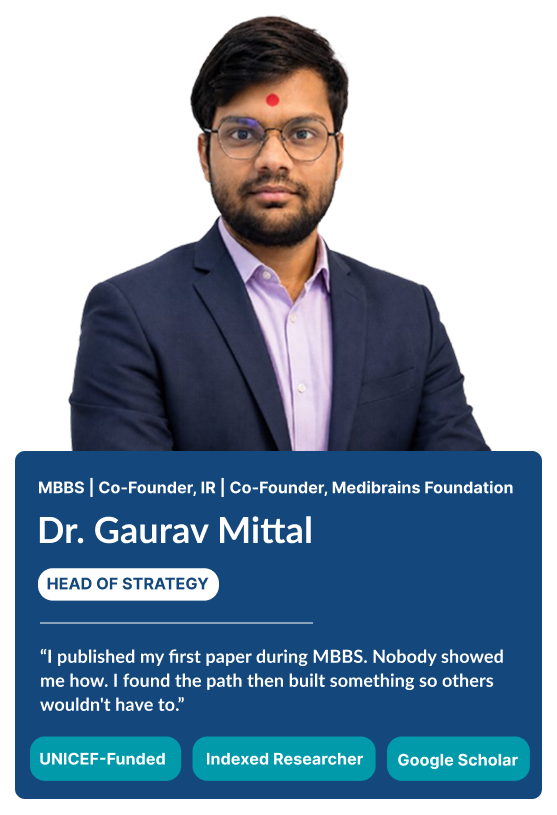
Learn more →OUR FOUNDERS
We Built this because We Needed it First

HOW IT WORKS
Clear process. No Drama
Research Strategy
We understand your goals, evaluate your research, and create a structured publication plan.
Manuscript Development
Work collaboratively to develop a manuscript that reflects your research and meets journal standards.
Submission & Peer Review
Submit to the right journal and continue through reviewer comments, revisions, and resubmissions.
Published & Indexed
Our commitment lasts until the work is searchable and recognizable under your name across reputable, indexed academic platforms.
TESTIMONIALS
“Very helpful and supportive when asked for given at any point. Dr. Prashanth also was kind enough to clear all our doubts without hesitation which made him approachable”
Vishal kalmani
“Dr. Prashant helped a lot with our research and guided us from start to finish, helped us throughout the long process, every step of the way.”
Dhyaneshwar Ra
“MY paper got selected in IJOO ( Indian Journal of otorhinolaryngology) . Infinitely and eternally greatful to the team which helped me in drafting and submission of paper ! Buttery smooth process.....”
Rajlaxmi Korpe
Recent Publications
A selection of recently published papers secured by doctors in our program.
Short V/S Standard-Length Implants: A Systematic Review on Clinical Outcomes and Success Rates
Artificial Intelligence in Oral Cancer Diagnosis: A Systematic Review
Atypical Presentation of Autoimmune Encephalitis
Most research services disappear after submission.
That's usually where the difficult part starts.
WE STAY UNTIL INDEXED
Rejections. Revisions. Resubmissions. Included.
EVERY MANUSCRIPT IS DOCTOR-REVIEWED
Because journals notice weak structuring immediately.
0 PREDATORY JOURNALS
PubMed. Scopus. Embase only. One wrong journal can follow a doctor for years.
YOU CAN DEFEND EVERY WORD
Interview. Viva. Promotion review. The work still sounds like you.
PRICE BEFORE COMMITMENT
No hidden pricing calls halfway through the process.
WHO WE HELP
Different doctors. Same invisible gap.



KNOWLEDGE HUB
Latest from The Lab
Insights on medical publishing, portfolio building, and clinical research strategy.
The 2026 Guide to PubMed Indexing for IMGs
A deep dive into how the NHS and residency programs are weighting publications in the upcoming application cycle.
Systematic Reviews vs. Meta-Analysis
Understanding which evidence level your data supports and which one will yield the highest citations.
Spotting Predatory Journals in 3 Steps
Don't burn your data. Learn the red flags that indicate a journal might be blacklisted by medical boards.
COMMON INQUIRIES
Your Questions. Answered.
The technicalities of medical publishing can be complex. We’re here to simplify them.
While journal review times vary, our internal processing (from data audit to submission) typically takes 4–6 weeks. Once submitted, peer review can take anywhere from 2 to 6 months depending on the journal's impact factor.
Yes. We specialize in "Resubmission Strategy." We analyze the reviewer comments, address the methodology gaps, and re-engineer the manuscript for a journal that is a better fit for your data.
No ethical research organization can "guarantee" acceptance in peer-reviewed journals. However, we guarantee that your paper will meet all technical and protocol standards for indexing, significantly reducing the risk of desk rejection.
Absolutely. We act as clinical research consultants. We do not "ghostwrite" fabricated data; we help you structure and present your actual clinical findings according to international ICMJE guidelines.
Not sure yet?
That's what the first call is for. 20 minutes. No slides. No sales pitch. No pressure to commit.
Just an honest conversation about:
Where you are
What timeline you're working against
Whether this is realistically possible
If the timeline doesn't make sense, we'll tell you that too.
Talk to a Doctor
20-minute strategy session
Reserve a slot to discuss your clinical data and residency trajectory. No obligations, just expertise.
Available Today
Schedule a Call